
The Investigator Reflex
— Your Results —
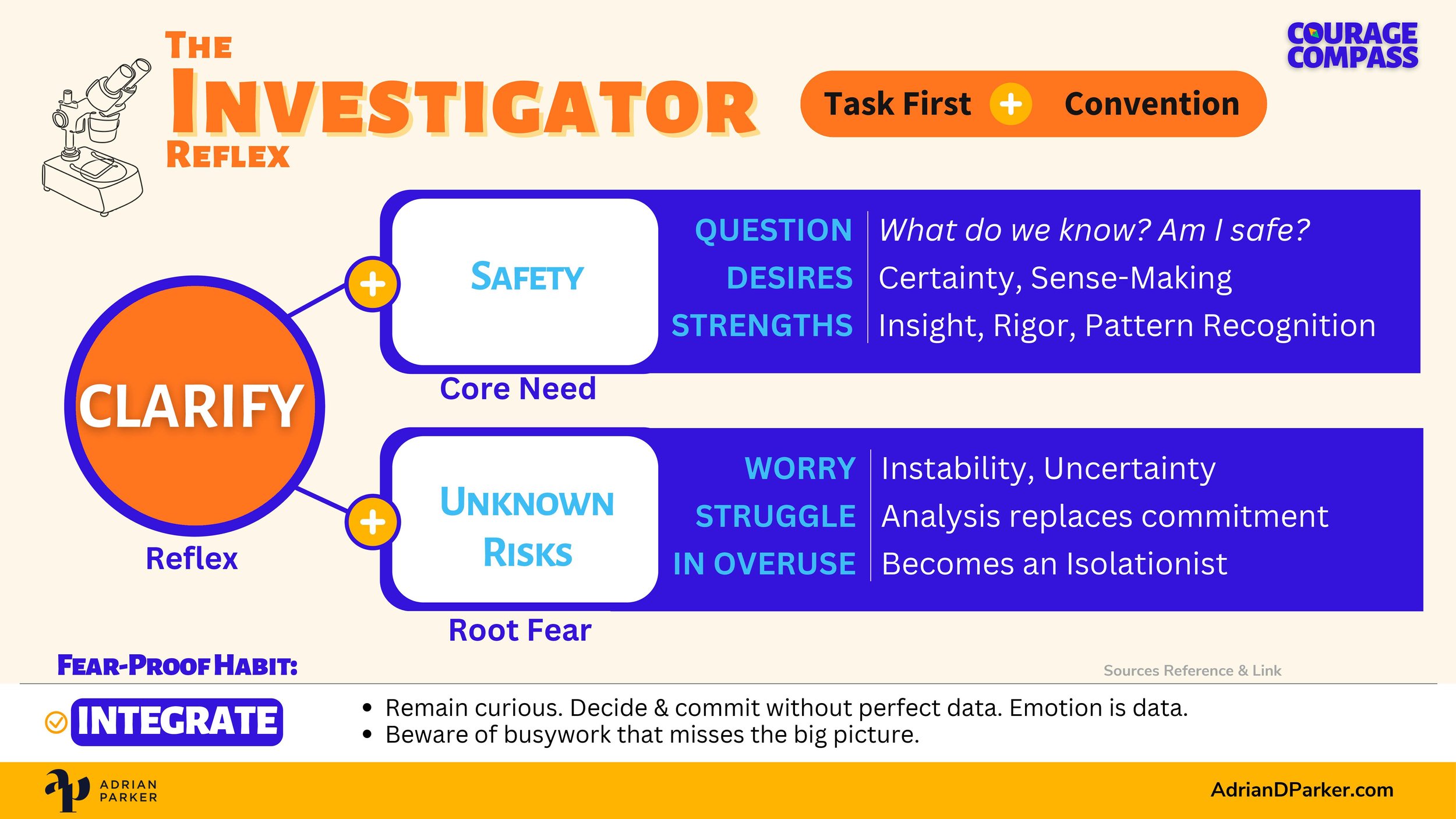
Based on your results, your natural response to fear may be The Investigator Reflex.
You naturally seek certainty and recognize patterns, not to predict but to prepare.
NATURAL REFLEX
Clarify
Make sense of risks & maximize insights.
ROOT FEAR
Unknown Risk
Ambiguity, volatility, uncertainty
CORE NEED
Safety
Certainty, stability, reality
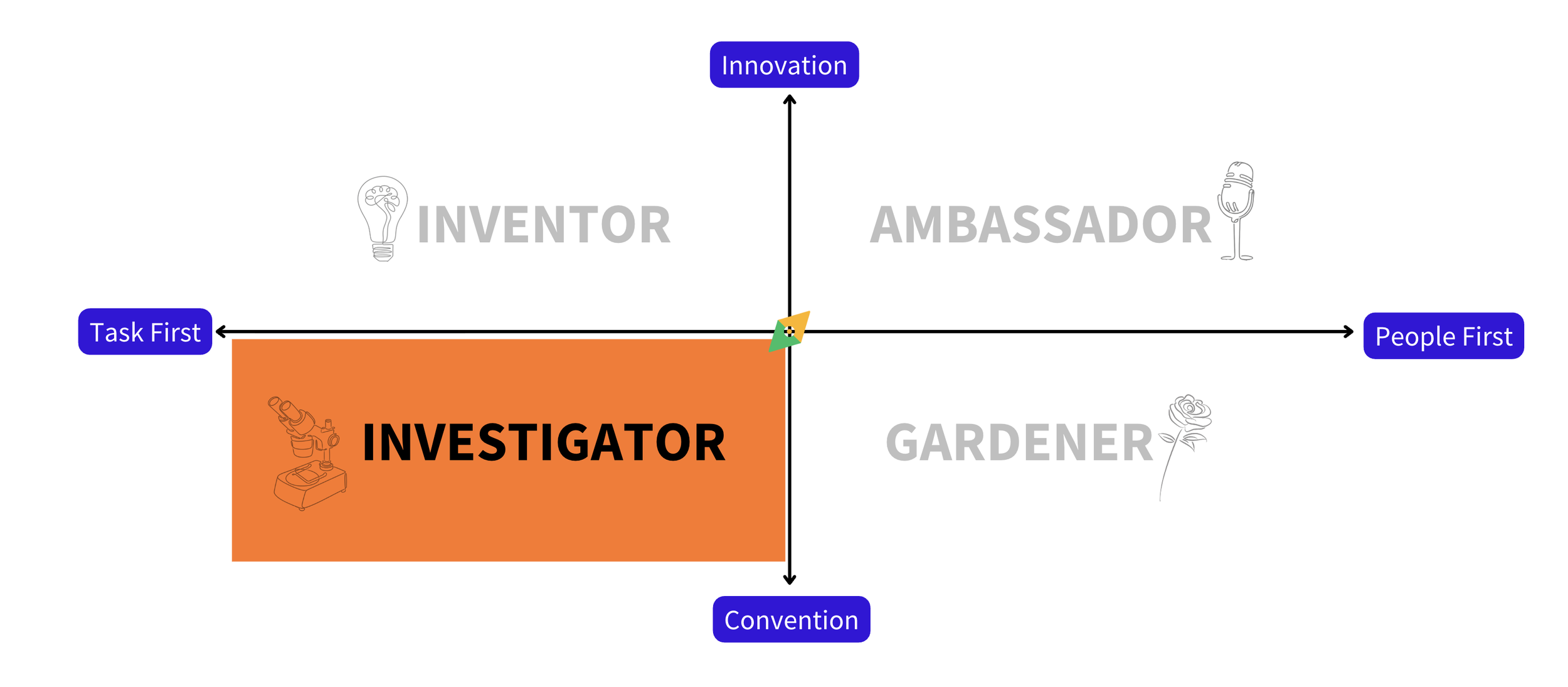
QUESTIONS
What do we know?
Am I safe?
Can I trust you?
STRENGTHS
Examine problems to seek insights and connect dots that can minimize risks.
Natural rigor helps stabilize systems in times of ambiguity, ensuring "safety checks" along the way.
STRUGGLES
Under stress, analysis can replace commitment and be experienced by others as bureaucracy or busywork.
In overuse, The Investigator Reflex becomes an Isolationist, admiring data points while missing the big picture.
Fear-Proof Habit: INTEGRATE
Emotion is data. Instincts are insights.
Remain curious. Decide & commit without perfect data to get more confident in managing the tension between great & good enough.
Don't let caution replace commitment to act. Use sound judgment to optimize safety without lingering in avoidance.
Be whole-brained. A champion of both conventional information and unconventional instinct.
A Fear Reflex isn’t about what you do…
It’s about what you reach for first when a Core Need feels at risk.
Fear detects that a risk is present. Courage decides to deal with it.
Fear is a human emotion. Courage is a healthy reaction.
Fear is the father of courage.
Courage is an agreement to act on your beliefs before you know the cost. The opposite of courage is not fear, it’s conformity. To take the shape of something or someone you were never designed to be.
Courage is the practice of converting our natural fears…
into Fear-Proof habits that build trust, community and results. It is a renewable energy source that compounds as you use it.
Here’s the challenge:
At work, most of us were taught to disable our social and emotional “risk detectors.”
We treat fear as something to avoid, ignore or mis-use. When fear is an enemy to defeat we miss the very signals & data it’s designed to communicate.
But these habits undermine trust by transforming co-workers into competitors, not community. Trust me, I’ve been there.
But there’s a truer way to work, lead and succeed. This evidence-based, practical tool will help you discover the natural pattern shaping how you respond, decide and act under stress. Take the 2-minute assessment today!
Overview of the 4 Fear Reflexes
-
“If I create something new, I’ll stay ahead.”
The Inventor Reflex responds to uncertainty by generating ideas, options, and momentum. They build, pivot, and innovate to regain control when things feel stuck.
At their best, they unlock possibility and forward movement. Under stress, they may outrun alignment—creating more change than clarity.
-
“If I understand this fully, I’ll be safe.”
The Investigator Reflex seeks certainty through data, logic, and careful analysis. They reduce risk by asking the right questions and testing assumptions.
At their best, they bring clarity and credibility. Under pressure, they can stall progress—waiting for perfect information before committing.
-
“If we stay connected, we’ll survive.”
The Gardener Reflex moves toward people when things get tense. They build trust, harmony, and shared understanding to reduce conflict and risk.
At their best, they unify teams and foster belonging. Under pressure, they may avoid hard truths to keep the peace or resist necessary change to preserve order.
-
“If I mobilize people, we’ll move forward.”
The Ambassador Reflex responds to pressure by inspiring action. They translate beliefs into behavior through story, influence, and shared purpose.At their best, they create momentum and unite people around what matters most. Under stress, influence can drift into image-management—where appearing right matters more than acting rightly.
Want to learn more? Invite me to lead a virtual session with your team today.
Articles

Your current resume might be sufficient to get you noticed as a good candidate. But is it working hard enough to communicate why you're the obvious candidate?